
How to Read Your Furnace's AFUE Rating (and Why a Higher Number Doesn't Always Mean Lower Bills)
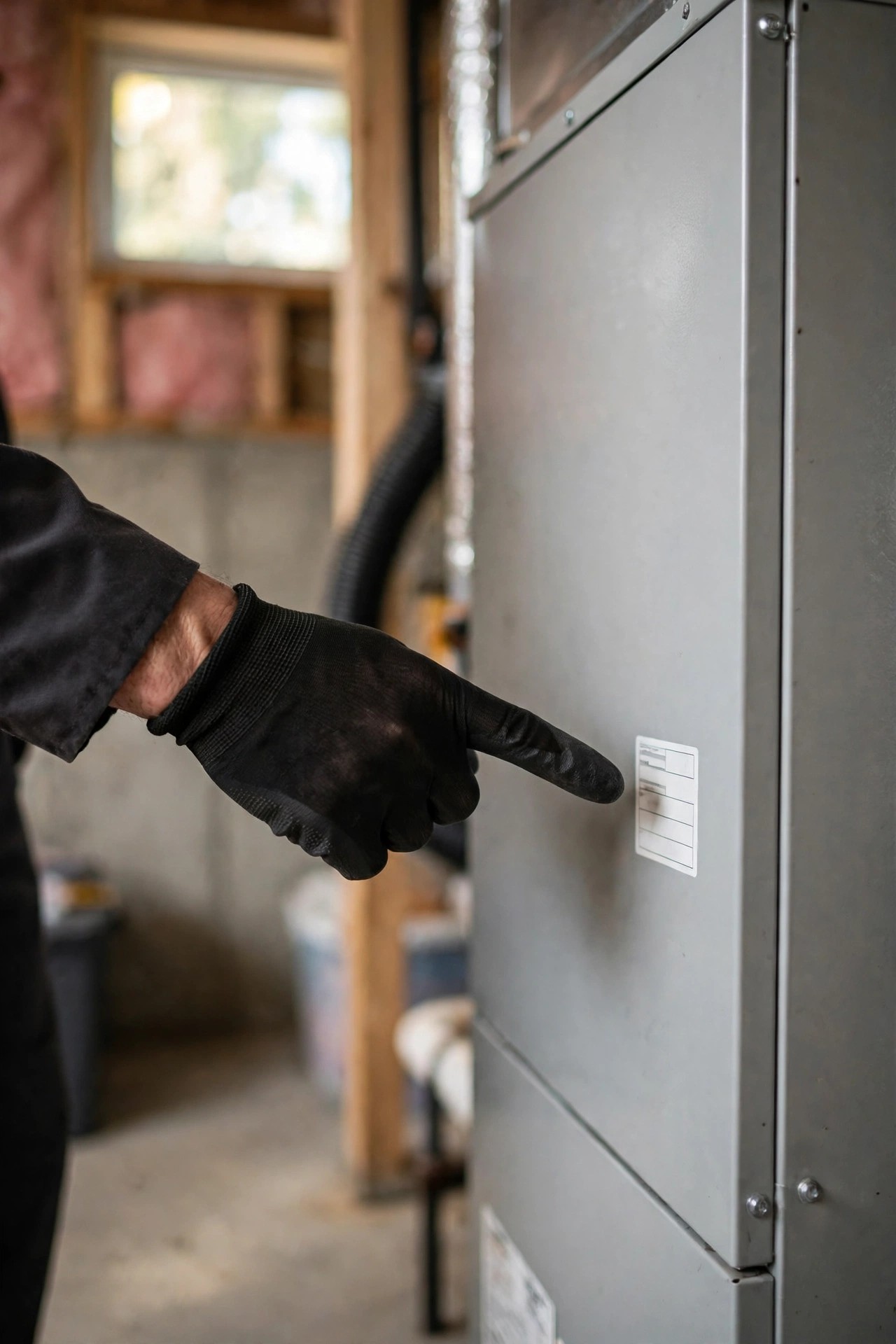
Every furnace sold in Ontario comes with a sticker somewhere on the cabinet showing an AFUE number — 92%, 95%, 96%, sometimes higher. Homeowners assume the bigger the number, the smaller the gas bill, and salespeople don't always go out of their way to correct that. It's not wrong, exactly. It's just a lot less simple than it looks.
What AFUE Actually Measures
AFUE stands for Annual Fuel Utilization Efficiency. It's a measure of how much of the fuel your furnace burns over a full year actually turns into usable heat for your home, versus how much escapes unused through the flue or exhaust. A furnace rated at 95% AFUE converts 95 cents of every dollar of gas into heat for your living space; the other 5 cents goes out as exhaust. It's a real, standardized number — tested the same way across manufacturers — so it's a fair way to compare furnace to furnace. What it doesn't measure is your whole heating system, your ductwork, or your actual gas bill, which is where the confusion usually starts.
Ontario's Furnace Market Already Has a High Floor
Something a lot of homeowners don't realize: federal efficiency regulations have required a minimum 90% AFUE on most new residential gas furnaces sold in Canada since 2010. That means the "standard efficiency" furnace at the bottom of a quote sheet today is already a condensing furnace, not the 78–80% units that were still common in older homes. So when you're comparing options, you're almost always choosing between, say, 92% and 97%, not between 80% and 97%. That's a much smaller gap than the marketing often implies.
Where the "Higher Number = Lower Bill" Logic Breaks Down
Diminishing returns. Going from 80% to 90% AFUE cuts your wasted fuel roughly in half. Going from 92% to 97% cuts the waste from 8% to 3% — a real improvement, but on a much smaller slice of your total gas use. The dollar savings from that last few points are genuinely modest for most homes, especially weighed against the up-front cost difference between models.
AFUE only grades the furnace, not the system around it. Leaky or undersized ductwork, poor attic or basement insulation, a thermostat left on wide temperature swings, or a furnace that's oversized or undersized for your home can all waste more energy than the difference between a 92% and a 97% unit ever will. I've been into homes running a top-tier furnace through ductwork that's losing 20–30% of the heated air before it reaches the vents — the AFUE rating on the furnace itself barely matters at that point.
Installation quality matters as much as the rating on the box. A high-efficiency condensing furnace needs proper venting, a working condensate drain, and correct airflow setup to actually perform at its rated efficiency. A 97% AFUE furnace installed poorly can easily underperform a well-installed 92% unit.
So How Should You Actually Choose?
For most Ontario homes, the honest answer is: don't pick a furnace purely by chasing the highest AFUE number on the spec sheet. Look at the whole picture — how long you plan to stay in the home, what your current ductwork and insulation situation actually is, and what the real price difference is between efficiency tiers for your specific furnace size. A technician who actually measures your home's heat load, rather than quoting off the furnace size you already have, is going to save you more money long-term than an extra point or two of AFUE.
Get It Sized and Installed Right
This is the part I'd rather homeowners spend their attention on than the sticker. We've been installing and servicing furnaces across the GTA, Hamilton, London, Kitchener-Waterloo, and Ottawa since 2012, with licensed, TSSA-certified technicians doing proper load calculations before recommending any specific furnace — not just upselling the highest AFUE unit on the truck.
If your furnace is getting old, or you just want a second opinion on a quote that leans hard on an AFUE number, call 1-888-705-7368 for a free quote. We'll walk through your actual home, not just the spec sheet, before recommending a new furnace. We serve homeowners in Toronto, Hamilton, Kitchener-Waterloo, and Ottawa.
FAQs
Q: Is a 96% or 97% AFUE furnace always worth the extra cost over a 92% unit?
A: Not always. The fuel savings between those two ratings are real but modest, since both are already condensing, high-efficiency units. Whether the price difference pays for itself depends on your gas use, how long you'll stay in the home, and the actual quote difference — a technician can run the numbers for your specific situation.
Q: Does Ontario require a minimum AFUE for new furnace installations?
A: Federal regulation has required at least 90% AFUE on most new residential gas furnaces sold in Canada since 2010, so nearly every furnace installed today, even "standard" options, is already a high-efficiency condensing unit.
Q: Besides AFUE, what else affects my heating bill the most?
A: Ductwork condition and sizing, insulation levels, thermostat habits, and whether the furnace itself is correctly sized for your home typically have a bigger impact on your actual gas bill than small differences in AFUE between efficiency tiers.
A note from Bilal: I use AI to help draft these articles, but I read and approve every one before it goes up.