
How Long Should Your HVAC Equipment Last? (Honest Answers)
How Long Should Your HVAC Equipment Last? (Honest Answers)
When people ask how long their furnace, air conditioner, heat pump, or water heater should last, they deserve a straight answer — not a vague range designed to hedge every scenario. This article gives you realistic, honest expectations for each major type of HVAC equipment, along with the factors that actually move the needle on lifespan.
Why Equipment Lifespan Varies
Published lifespan estimates for HVAC equipment are nearly always given as ranges, and for good reason: the gap between the low end and the high end of that range is real, and the factors that determine where your equipment lands are not random.
The biggest drivers of equipment lifespan:
● Installation quality: Equipment installed incorrectly — wrong refrigerant charge, improperly sized ductwork, poor electrical connections — begins degrading from day one.
● Annual maintenance: Equipment that receives regular professional servicing consistently outlasts neglected systems by several years.
● Filter maintenance: Clogged filters force equipment to work harder, raising operating temperatures and stressing components. Replacing filters on schedule is the single easiest way to extend equipment life.
● Usage patterns: A system running 14 hours a day in an extreme climate faces more wear than one in a mild-climate home where it cycles on and off a few times a day.
● Brand and build quality: There are real differences in component quality across manufacturers. Premium brands built to higher tolerances tend to last longer — especially at the high end of their stated range.
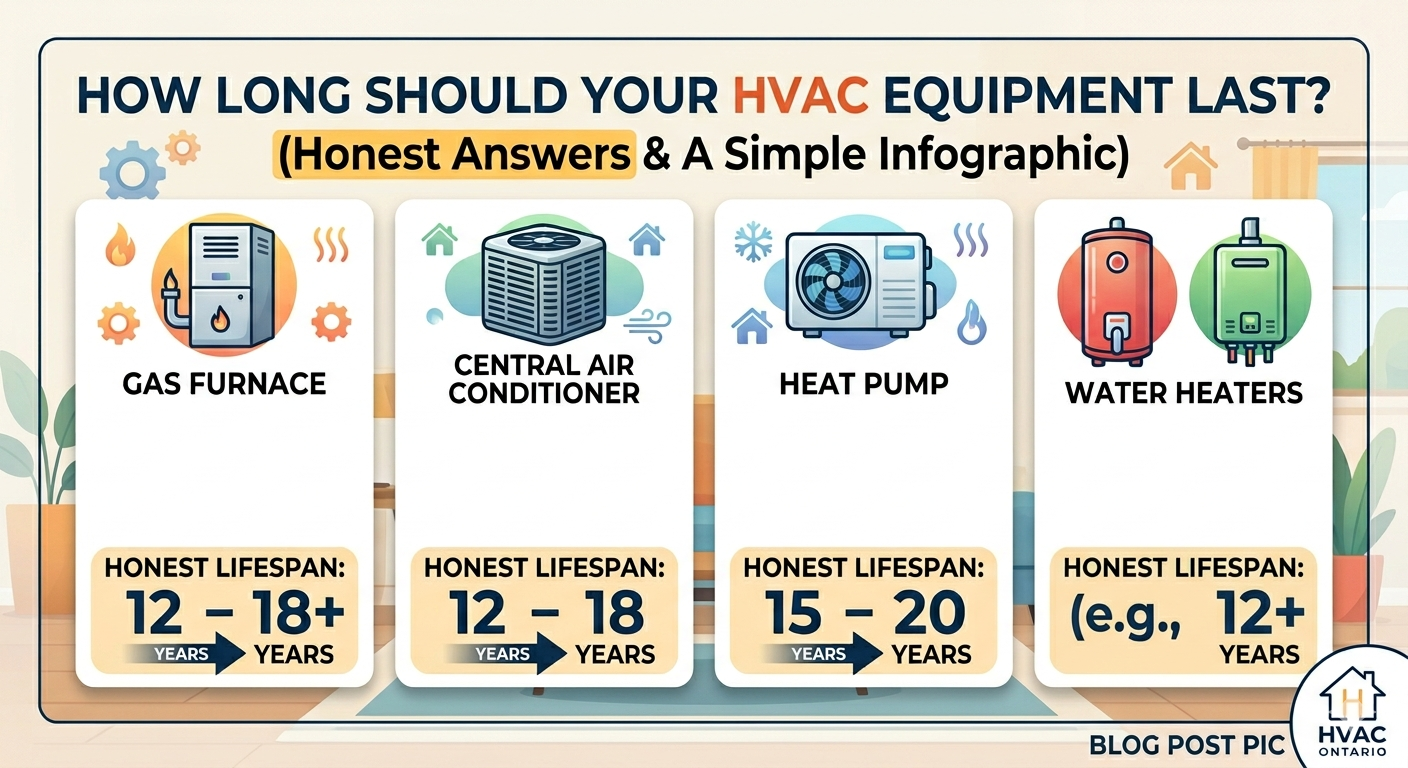
Furnaces: 10 to 18+ Years
A well-maintained, properly installed natural gas furnace in Ontario typically lasts 10 to 18+ years. Most fall somewhere in the middle of that range — around 12 to 15 years — under average conditions.
What shortens a furnace's life:
● Chronic short-cycling from improper sizing (see our article on furnace sizing)
● Skipped annual furnace tune-ups
● Running with a dirty filter for extended periods
● Combustion issues that go uncorrected (often discovered during annual service)
What extends it:
● Annual professional maintenance — including heat exchanger inspection, burner cleaning, and flue check
● Regular filter replacement (every 1–3 months depending on filter type)
● Prompt attention to any unusual noises, smells, or performance changes
When to start planning for replacement: When a furnace reaches 15 years and begins requiring repairs, it is worth getting a replacement assessment — not because the unit is necessarily dead, but because repair costs on aging equipment can accelerate quickly, and the efficiency gains from modern furnaces are substantial.
Explore furnace replacement options at HVAC Ontario's furnace page (https://www.hvacontario.ca/buy-furnace).
Central Air Conditioners: 12 to 18 Years
Central air conditioners have a shorter expected lifespan than furnaces in most climates. In Ontario, 10 to 18 years is a reasonable range, with most units performing reliably for 12 to 14 years under good maintenance conditions.
The outdoor component — the condenser — takes significant environmental punishment. UV exposure, debris, extreme temperature swings, and occasional physical contact all contribute to gradual degradation.
Signs an AC unit is approaching end of life:
● Multiple service calls in a single cooling season
● Refrigerant leaks (particularly if the unit uses phased-out R-22 refrigerant)
● Compressor issues — the compressor is the most expensive single component, and repairing it in a unit over 10 years old rarely makes financial sense
● Persistent humidity issues even when the system is running properly
● SEER rating well below current standards, creating a significant ongoing electricity cost
Heat Pumps: 15 to 20 Years
Heat pumps are often assumed to wear out faster than furnaces because they operate year-round — both for heating and cooling. In practice, 15 to 20 years is a realistic lifespan for a well-maintained heat pump.
Because a heat pump handles both heating and cooling seasons, annual professional maintenance is particularly important. Refrigerant charge, coil condition, defrost cycle performance, and electrical component integrity all affect reliability over time.
Cold-climate heat pumps — designed to operate efficiently at outdoor temperatures down to -25°C or lower — are well-suited to Ontario winters and represent the current generation of technology. They are built to handle the thermal cycling demands of year-round operation in Canadian climates.
Explore heat pump options at HVAC Ontario's heat pump page (https://www.hvacontario.ca/heatpumps).
Tankless Water Heaters: 12+ Years
Tankless water heaters consistently outlast traditional tank water heaters by a meaningful margin. While a standard hot water tank typically lasts 8 to 10 years, a well-maintained tankless unit — particularly from a premium manufacturer like Rinnai — can perform reliably for 12 years or more.
The longevity advantage comes from how tankless units work: because there is no standing water stored under constant heat and pressure, the corrosion and mineral buildup that kills tank heaters develops far more slowly. Tankless units also benefit from the fact that when a component does fail, it is typically a serviceable part — the whole unit rarely needs replacement for a single component failure.
Key maintenance for tankless longevity:
● Annual descaling: In areas with hard water (which includes many parts of Ontario), mineral scale builds up in the heat exchanger over time and must be flushed periodically. Neglecting this is the primary cause of premature tankless water heater failure.
● Inlet filter inspection: A clean water filter protects the internal components.
● Venting inspection: Proper venting is critical for both performance and safety.
Learn more about tankless water heater options at HVAC Ontario's tankless page (https://www.hvacontario.ca/buy-tankless-water-heater-now).
Traditional Hot Water Tanks: 8 to 10 Years
For homeowners still running a traditional tank water heater, the expected lifespan is 8 to 10 years — with most reaching failure somewhere in that window. The primary failure modes are tank corrosion and anode rod depletion, both of which are gradual processes that eventually result in a leak or loss of heating capacity.
Unlike a furnace or heat pump that declines in performance before failure, a water tank often gives limited warning. This is why many HVAC professionals recommend replacement before the unit hits 10–12 years, rather than waiting for a failure — particularly since a failed tank means no hot water until a replacement is installed.
The Bottom Line
The best strategy is not to wait for equipment to fail. Plan replacements based on age and performance trends — and have the conversation with an HVAC professional before you are facing a winter emergency or a no-hot-water situation.
At HVAC Ontario, that conversation happens over the phone. No in-home salespeople, no pressure — just a straightforward assessment and honest answers. Call 1-888-705-7368 any time.