
Tankless Water Heater Weak in Winter? Here's What's Normal (and What Isn't)
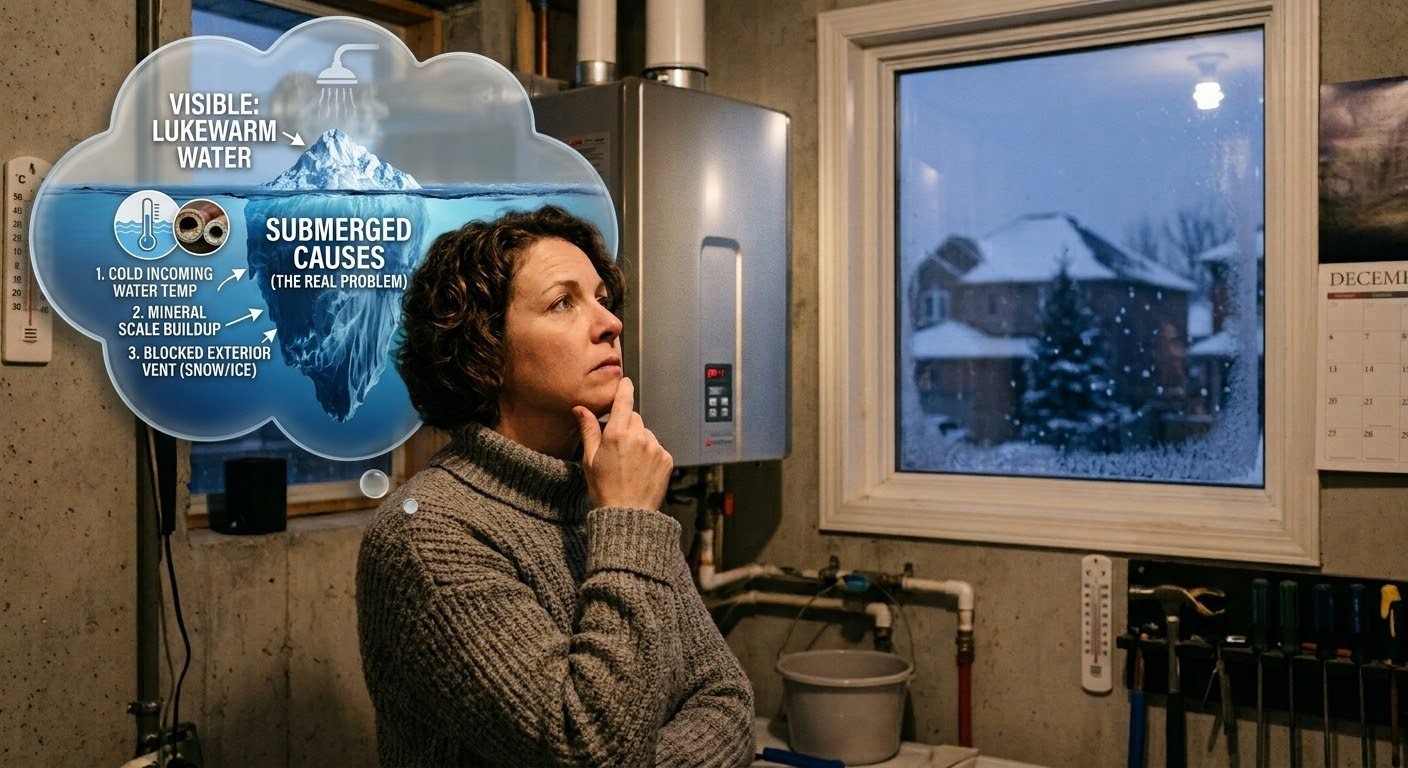
Every winter, right around the first real cold stretch, I start getting calls that sound almost identical: "My tankless water heater worked fine all year, and now the shower won't get hot" or "it was fine last week, now it's lukewarm no matter what I do." Before anyone assumes their unit is failing, it's worth understanding what's actually normal for a tankless system in a Canadian winter, and what's a genuine problem worth a service call.
Why Tankless Units Feel Weaker Once It Gets Cold
A tankless water heater doesn't store hot water, it heats it on the spot as it flows through the unit, and raises the temperature by a fixed amount for a given flow rate. The colder the water coming into your house, the bigger that temperature rise has to be to hit a comfortable tap temperature, and the harder the unit has to work to get there. In summer, incoming municipal water might only need to be warmed 30 to 40 degrees. In the middle of an Ontario winter, that same unit might need to raise the water temperature 70 degrees or more. The unit can't just "try harder" past its rated capacity, so the maximum flow rate it can deliver at full temperature actually drops. That's physics, not a malfunction, and it's the single biggest reason a tankless system that felt plenty powerful in July can feel undersized in January.
What's Normal vs. What Isn't
A modest drop in flow rate when two or three fixtures run hot water at once is expected in winter. If your shower holds steady but a second tap or the dishwasher kicking in makes it dip slightly, that's the unit doing exactly what it's rated to do at a bigger temperature rise.
What isn't normal: lukewarm or cold water with only one fixture running, water that cycles between hot and cold repeatedly, an error code on the unit's display, or no hot water at all. Those point to an actual problem, not just winter physics.
Common Culprits Beyond the Weather
A few things we check on these calls every winter:
The unit was borderline-sized to begin with. If it was comfortable in summer but you've never loved it in winter, it may have been sized for average conditions rather than Ontario's coldest incoming water temperatures, which is a sizing conversation worth having.
Scale buildup inside the heat exchanger. Mineral scale narrows the internal passages over time and reduces how efficiently the unit can transfer heat, which shows up as a slow decline in performance, often most noticeable once winter raises the demand. Annual descaling maintenance is the fix, and it's cheap insurance against this.
A frozen or iced-over vent or intake terminal. Tankless units vent combustion exhaust and pull combustion air through small pipes that terminate outside, and in a deep cold snap, snow or ice can partially block one. Most units will sense this and shut down or fault rather than run unsafely.
A recirculation pump or buffer tank issue, on models equipped with one, which can affect how quickly hot water reaches a far bathroom.
What You Can Safely Check Yourself
Look at the unit's display for an error code; most manufacturers list what each one means on a sticker inside the access panel. Check whether the problem happens at every fixture or just one, since a single weak tap often points to something at that fixture rather than the unit itself. And take a quick look outside at the vent and intake terminals to make sure they're not buried in a snowbank or capped with ice.
When to Call a Technician
Call right away if you see a flashing error code you don't recognize, smell gas near the unit, or the unit keeps locking out after you reset it. Those are safety-relevant faults, not DIY territory. Our licensed, TSSA-certified technicians handle these diagnoses constantly through the coldest stretch of the year, and most turn out to be quick, same-visit fixes once we can see the unit and your actual fixture layout.
Is It Time to Size Up?
If your household has grown, you've added a bathroom, or you've simply never been happy with performance even outside of winter, it may be time to look at a larger tankless unit rather than keep troubleshooting around an undersized one. We also offer financing on new water heater installs if spreading out the cost makes more sense than a repair bill on an aging unit.
Don't Keep Guessing at a Cold Shower
If you've ruled out the easy stuff and you're still fighting your tankless system every morning, it's time to call. We offer tankless water heater repair across the Greater Toronto Area, Hamilton, London, the Tri-Cities, and Ottawa, including homeowners in Kitchener-Waterloo and the GTA, with technicians available 24/7.
Call 1-888-705-7368 for a free quote, or a straight answer on whether what you're seeing is normal — we're available around the clock across the GTA, Hamilton, London, Kitchener-Waterloo, and Ottawa.
FAQs
Why does my tankless water heater seem weaker in winter than in summer?
Colder incoming water needs a bigger temperature rise to reach the same tap temperature, which naturally reduces the maximum flow rate a tankless unit can deliver at full output. A modest drop with multiple fixtures running is expected; a weak single tap or an error code is not.
Can a tankless water heater freeze or get damaged in an Ontario winter?
The unit itself is designed for this climate, but the exterior vent and intake terminals can ice over in extreme cold, which usually triggers a safety shutdown rather than damage. If power is lost for an extended period in severe cold, freeze protection features can still be overwhelmed, so it's worth asking us about freeze protection if your unit is in an exposed location.
Is it worth descaling a tankless water heater before winter?
Yes. Mineral scale gradually reduces how efficiently the heat exchanger transfers heat, and that efficiency loss tends to show up most obviously once winter raises the demand on the system. Annual descaling is inexpensive compared to a mid-winter service call.