
The Hidden Cost of Keeping Your Old Air Conditioner (And How to Fix It)
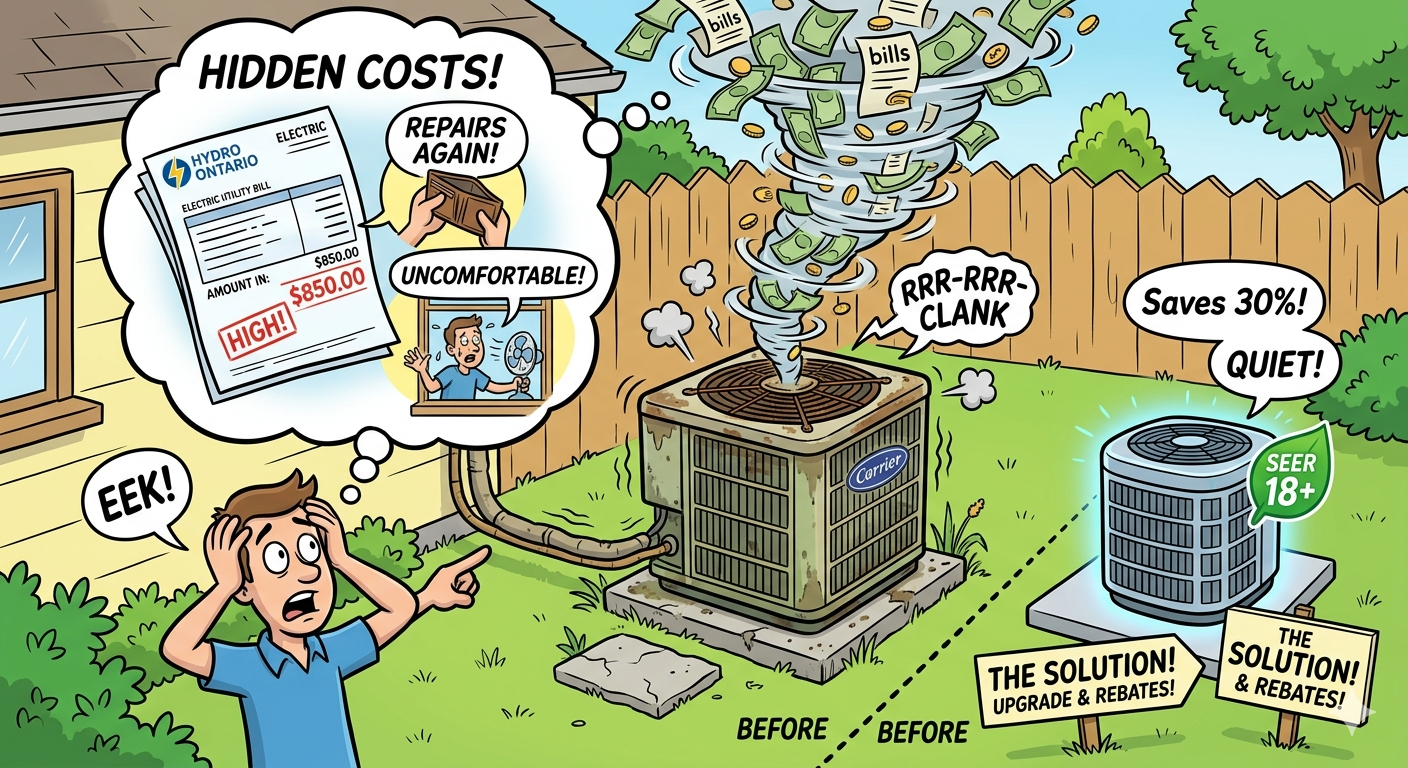
The Hidden Cost of Keeping Your Old Air Conditioner
Holding onto an aging air conditioner feels like the financially responsible choice — you've already paid for it, it still technically works, and replacement costs money. But for most Ontario homeowners, keeping an old AC is the more expensive decision. The costs just arrive differently: quietly, gradually, and spread across energy bills, repair invoices, and uncomfortable summers.
This article breaks down exactly what an aging air conditioner is costing you — and when the math tips firmly in favour of replacement.
The Efficiency Gap Nobody Talks About
The most significant hidden cost of an old air conditioner is not a repair bill. It is the electricity you are paying for every single month, month after month, that a modern unit would not require.
Here is the context: air conditioner efficiency is measured by SEER (Seasonal Energy Efficiency Ratio). The higher the SEER rating, the less electricity the unit consumes to produce the same amount of cooling.
A central air conditioner from the early 2000s might carry a SEER rating of 8 or 10. Today's standard new units start at SEER 13–14, and high-efficiency models reach SEER 20, 22, or higher. In practical terms:
● A SEER 10 unit from 15 years ago uses roughly 30–40% more electricity than a SEER 14 unit doing the same cooling job.
● Compared to a SEER 20 heat pump or air conditioner, an old SEER 10 unit can use twice as much electricity.
Multiply that inefficiency across every day of every cooling season for the remaining years you plan to stay in your home. The number adds up fast — often into the thousands of dollars over a five-year period.
Repair Costs: When "One More Fix" Becomes a Pattern
There is a tipping point in the life of any HVAC equipment where repairs stop being maintenance and start being a money drain. For air conditioners, that threshold often appears somewhere around the 10–12 year mark, though it varies by brand, maintenance history, and operating conditions.
Common signs that a unit is past its economical repair life:
● Refrigerant leaks: Older units use R-22 refrigerant (Freon), which has been phased out and is now scarce and expensive. A single refrigerant recharge on an R-22 system can cost several hundred dollars — and does not fix the underlying leak.
● Compressor failures: The compressor is the most expensive single component in an AC system. When it fails in an older unit, repair costs routinely approach or exceed the cost of a new, more efficient system.
● Repeat service calls: If you are calling for AC service more than once a summer — capacitors, contactors, coil cleanings, refrigerant top-ups — the cumulative annual repair spend is often well above what a new unit's financing payment would cost.
A useful rule of thumb: if a repair costs more than half the value of the unit, and the unit is over 10 years old, replacement almost always delivers better value.
The Comfort Costs
Older air conditioners also underperform in ways that cannot be easily priced — but are very real:
● Humidity control: Modern air conditioners and heat pumps are significantly more effective at removing indoor humidity during shoulder seasons (spring and fall). Older units running at 100% capacity often fail to dehumidify adequately, leaving homes feeling clammy even at acceptable temperatures.
● Uneven cooling: As coils age, fins deteriorate, and refrigerant levels drop, older units struggle to maintain consistent temperatures across all rooms.
● Noise: Aging compressors, deteriorating fan motors, and loose components create operational noise that new variable-speed systems virtually eliminate.
These are not trivial inconveniences. Persistent humidity and temperature discomfort are among the top reasons Ontario homeowners ultimately make the replacement call — sometimes years later than would have been financially optimal.
What Replacement Actually Costs — And What You Get Back
Modern AC replacement — or better yet, a heat pump that handles both heating and cooling — comes with meaningful financial support for Ontario homeowners:
● Up to $7,500 in rebates for baseboard or oil heated homes moving to electric heat pump for cooling and heating
● Up to $2,000 in rebates for natural gas / Enbridge customers installing a new heat pump instead of a traditional air conditioner.
● 0% financing through HVAC Ontario, making the upfront cost a non-barrier
HVAC Ontario handles all rebate paperwork. You do not need to navigate the process yourself.
When you factor in the efficiency savings, eliminated repair costs, rebates, and 0% financing, the total cost of staying with an old air conditioner is often higher than replacing it — even before you account for the improved comfort.
Explore your replacement options at HVAC Ontario's air conditioning page (https://www.hvacontario.ca/buy-air-conditioner).
When Is the Right Time to Replace?
Not everyone with a 12-year-old AC needs to replace it immediately. Here are the signals that indicate replacement is the right move now rather than later:
1. Your unit uses R-22 refrigerant — confirmed by your HVAC technician or the label on the outdoor unit. The phase-out makes servicing increasingly costly.
2. You have had two or more service calls in a single season.
3. Your summer electricity bills have increased noticeably without a change in usage habits.
4. The unit struggles to maintain temperature during peak summer heat, particularly in the hottest weeks of July and August.
5. Your unit is 15 years or older. The average lifespan of a well-maintained central AC is 15–20 years, but efficiency and reliability decline well before total failure.
Get a Real Answer, Not a Sales Pitch
At HVAC Ontario, we give straightforward assessments over the phone. Tell us about your current unit — age, any recent repairs, current cooling performance — and we will give you an honest read on whether repair or replacement makes more sense for your situation.
No in-home salespeople. No pressure. Just a real conversation.
Call 1-888-705-7368 and get a quote in minutes. Or visit our air conditioning page (https://www.hvacontario.ca/buy-air-conditioner) to explore your options.